Introduction
Digital Public Infrastructure (DPI) is the talk of the town in public policy circles. And why should it not be? DPIs have the potential to address some of the most fundamental development challenges facing societies and economies. From India’s Unified Payments Interface (UPI), to Estonia’s X-Road, to Brazil’s Pix, digital public infrastructure has demonstrated how shared digital foundations can transform service delivery, economic participation and institutional efficiency.
However, there is another side to this story.
Not every ambitious digital infrastructure initiative achieves its intended objectives. Across countries and sectors, governments have invested considerable financial, institutional and technological resources in building digital systems that have struggled to achieve meaningful adoption, ecosystem participation or public value. There are several instances of digital addressing, identity verification, digital identification and digital commerce initiatives that illustrate the challenges of translating ambitious digital infrastructure plans into sustained public utility.
These are the kinds of initiatives that motivate what I call Ghost DPIs.
Borrowed from the idea of ghost (physical) infrastructure, the term draws an analogy with the multi-million-dollar highways, bridges and other infrastructure projects that are built but attract little or no meaningful utilisation. China’s widely discussed ghost towns offer another illustration of the gap between infrastructure creation and actual demand.
A similar phenomenon can emerge in the digital domain. A government may commission an elaborate digital platform, develop APIs, onboard institutions, establish technical standards and invest millions in its implementation. Yet, years after its launch, the infrastructure might remain substantially disconnected from the very people, institutions and ecosystems it was intended to serve.
Of course, no government, developer or policymaker can accurately predict the eventual success of every DPI initiative. Innovation involves uncertainty, and some infrastructure takes years to mature. However, there are identifiable warning signs that can indicate when a DPI is drifting towards becoming a ghost.
Recognising these signs early, and designing infrastructure around sustained adoption and public value rather than merely successful deployment, is essential if we are to avoid creating the next generation of Ghost DPIs.
What are Ghost DPIs
A Ghost DPI is a digital public infrastructure initiative that, despite investment in its development and deployment, fails to achieve meaningful, sustained and socially relevant utilisation, thereby remaining substantially disconnected from the public, institutions or ecosystems it was intended to serve.
There are broadly three elements that can help identify a Ghost DPI:
1. Substantial Deployment: The DPI exists in a sufficiently developed and operational form. It has moved beyond the conceptual, planning or initial pilot stage and has been deployed to a meaningful extent. 2. Underutilisation: Actual adoption, usage volumes, institutional integration or ecosystem participation remain significantly below the intended objectives or the infrastructure’s potential. 3. Unrealised Public Value: Despite its deployment, the DPI fails to generate the intended developmental, economic or governance outcomes.
Substantial deployment is essential, while underutilisation and lack of public value indicate the extent of the problem. A DPI that is substantially deployed but falls short on either of the other two parameters may be considered a potential Ghost DPI.
It is also important to distinguish between a failed DPI and a Ghost DPI. A failed DPI is an initiative that fails to reach meaningful deployment or ceases to function, owing to constraints such as inadequate funding, technical limitations, legal impediments or operational difficulties. Its failure may occur before the infrastructure has had a reasonable opportunity to demonstrate its utility.
A ghost DPI, on the other hand, is an initiative that has crossed the deployment threshold but fails to translate its existence into meaningful and sustained public utilisation or value. It may have received considerable funding, technical attention and institutional backing, and may even be fully operational. Yet, it remains disconnected from the ecosystem it was designed to serve.
Put simply, a failed DPI struggles to come into existence; a ghost DPI exists, but struggles to justify its existence.
Making of a Ghost DPI
Like any product or service, a DPI’s prospects can be assessed through fair, objective and evidence-based evaluation. While no assessment can predict the future with certainty, certain indicators can help identify whether an initiative is likely to realise its intended objectives. These indicators are not mutually exclusive, and a DPI may exhibit several of these weaknesses simultaneously.
Problem–Solution Disconnect
This cannot be stressed enough. A DPI must have a clear problem–solution connect. However, initiatives that eventually become Ghost DPIs often fail to objectively assess this relationship, falling prey to technological solutionism, confirmation bias and institutional biases.
A Ghost DPI often begins with a perceived panacea and then looks for a problem or demand to justify its existence. In other instances, it attempts to replicate a seemingly successful model, either within the country or abroad, without adequately considering local requirements, institutional capacity or existing alternatives.
The approach should be the other way around: identify the problem first and then explore whether a DPI is the appropriate solution. The objective should be to solve an existing problem, not invent one to justify a technological solution.
Adoption Gap
Adoption can broadly take three forms: mandated, assisted and organic. Mandated adoption is driven by government directives or institutional requirements; assisted adoption relies on awareness, training and facilitation; while organic adoption occurs when users voluntarily choose a DPI because it offers tangible value. While all three may be necessary, sustained organic adoption is perhaps the strongest indicator that a DPI is genuinely serving its intended purpose. This does not necessarily mean that every DPI must achieve mass organic adoption; some essential public infrastructures may require continued institutional facilitation.
High registration numbers do not necessarily translate into genuine adoption. The government may be able to onboard millions of users onto a platform. However, sustained usage cannot be practically mandated.
If a DPI fails to reduce user friction, or instead introduces additional steps and complexities, users have little reason to continue using it once the initial push subsides. Low public awareness, digital literacy, accessibility and the availability of alternatives must also be factored into its design. A technically sound solution may exist and be accessible on the internet, but that alone does not make it useful. If it is difficult to navigate, unreliable or fails to offer tangible value to its intended users, adoption is unlikely to sustain itself. Ultimately, users need a compelling reason to choose the DPI, whether through greater convenience, reduced costs, improved accessibility or other tangible benefits.
Public Value Deficit
A DPI can easily be presented as a success through registration numbers, downloads, API calls or user ratings. However, these metrics can sometimes mask a more fundamental question: is the infrastructure actually creating public value?
Merely digitising an existing workflow is not enough. A DPI should ideally make a tangible difference to the people and institutions it is intended to serve. This could mean improved efficiency, reduced costs, greater affordability, wider inclusion, better accessibility or improved quality of public services.
Ghost DPIs often lack convincing evidence of such improvements. Their reporting may focus extensively on outputs and activity metrics while remaining relatively silent on actual developmental outcomes. The distinction is important: building an API is an output; reducing the time, cost or complexity of accessing a public service is an outcome.
Ultimately, the success of a DPI should not be measured merely by how many people have registered or how many transactions have been processed, but by whether it has meaningfully improved the lives of its intended beneficiaries and done so at scale.
Ecosystem and Integration Gap
The importance of ecosystem enablement in the success of a DPI is well established. DPIs cannot succeed in silos. Public and private ecosystem participants must be aligned and actively contribute towards the DPI’s intended objectives and outcomes.
However, integration alone is not enough. There is an equally important need for clear institutional demarcation, ownership and accountability. Who is responsible for operating the infrastructure? Who maintains it? Who is accountable for resolving failures? Who decides its future direction?
When institutional responsibilities overlap or remain undefined, coordination suffers, accountability becomes diluted and decision-making slows down. Multiple agencies may assume that another institution is responsible, while essential functions fall through the cracks. Similarly, the absence of clear ownership can make it difficult to secure long-term institutional commitment.
A DPI needs both integration and demarcation: integration to enable the ecosystem to function together, and demarcation to ensure that every participant knows its role and responsibilities. This is particularly important where the DPI involves multiple ministries, implementing agencies, technology providers and private ecosystem participants.
Sunk-Cost Trap
Sometimes, it is better to give up. Not every DPI initiative deserves to continue indefinitely, particularly when repeated attempts at course correction fail to deliver meaningful results.
Ghost DPIs may undergo multiple rounds of redesign, restructuring or repurposing, but a change in direction does not necessarily translate into a change in outcomes. Governments and implementing agencies must be willing to acknowledge when an initiative is no longer viable.
The reluctance to discontinue a project often stems from sunk costs, institutional prestige, bureaucratic ownership or the reluctance to admit failure. However, money already spent is not a justification for spending more. Continuing to fund an underperforming DPI also carries an opportunity cost: those resources could potentially be redirected towards more effective public interventions.
Periodic independent evaluation, clear performance thresholds and predefined exit mechanisms can help determine whether a DPI should be continued, redesigned, merged with an existing system or discontinued altogether. Sometimes, the best public policy decision is to stop investing in a solution that is no longer working.
Viability Gap
A DPI should not become an unnecessarily expensive, permanently subsidised operation without a clear justification for its continuing costs. While public funding may be necessary and entirely appropriate for essential digital infrastructure, its financial and operational sustainability must be considered from the outset.
The objective need not always be to generate profits or become self-financing. Rather, the infrastructure must demonstrate that its operational costs, maintenance requirements and continued public expenditure are proportionate to the value it generates.
High development and maintenance costs, recurring dependence on external vendors, weak ecosystem incentives and the absence of a sustainable operating model can turn a DPI into a long-term financial burden.
Being a digital initiative does not automatically justify high expenditure. Nor should the use of public funds be treated as an unlimited source of sustenance. Every DPI must be able to justify not only the investment required to build it, but also the resources needed to keep it running. This requires clarity on who bears the recurring costs, who is responsible for maintenance and upgrades, and how the infrastructure will remain operational over the long term.
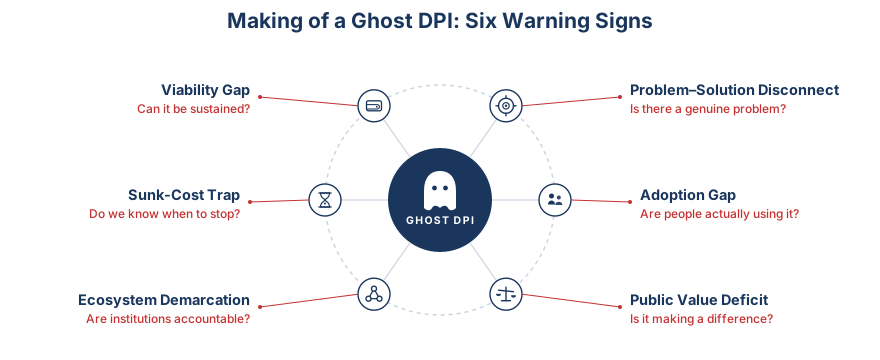
A Ghost DPI is rarely the consequence of a single bad decision. More often, it is the cumulative outcome of several oversights: a poorly defined problem, weak adoption, fragmented institutional ownership, limited public value and an unsustainable operating model. Recognising these warning signs early is therefore as important as getting the initial design right.
Preventing the Next Ghost DPI
Avoiding Ghost DPIs requires a shift in how we think about digital infrastructure. The focus must move from building and launching infrastructure to ensuring that it solves a genuine problem, attracts sustained participation and delivers measurable public value. A few principles can help guide this shift.
1. Problem First, Technology Second: Identify a genuine problem before developing a digital solution. Do not build infrastructure merely because the technology exists.
2. Design for Adoption: Prioritise user experience, accessibility and tangible benefits over registration targets and onboarding numbers.
3. Ecosystem Readiness: Robust institutional participation, interoperability, clear ownership and accountability before scaling..
4. Know When to Stop: Establish periodic evaluations, performance thresholds and exit mechanisms. Do not let sunk costs dictate future investments.
5. Measure Public Value: Focus on measurable improvements in efficiency, affordability, accessibility and inclusion rather than digital activity metrics alone.
6. Plan for Long-Term Viability: Ensure that financial, technical and institutional arrangements justify the long-term costs of operating the infrastructure.
Preventing Ghost DPIs is not avoiding experimentation or discouraging ambitious digital initiatives, rather, it is ensuring that ambition is accompanied by evidence, institutional readiness, accountability and a clear understanding of public value. Not every experiment will succeed, and that is acceptable. What matters is recognising when something is not working and responding before it becomes an expensive and enduring piece of digital infrastructure with little public purpose.
Step back, re-think. Build Less.
We must remember that A DPI is merely a means, and never the end. Technology cannot become the default or final solution to every problem. Sometimes, a few improvements to existing systems can solve a problem more effectively and offer a better return on investment (RoI) than building parallel infrastructure.
There must be accountability to the larger purpose, particularly when public finances are involved. Every rupee spent must have a reasonable justification and a clear connection to the public value it is expected to generate. Wasteful public expenditure is a failure of accountability to the public.
Deployments are milestones, not the goal. The real work begins at deployment. This must be kept in mind from the very beginning: design for the larger problem, not merely for a successful launch.
Before every major decision, step back and reconsider the proposed value creation, expected RoI, institutional readiness and potential roadblocks. Do not assume that technology is a magic wand.
Build less, do more. Happy Halloween!
Note: I have deliberately refrained from naming specific DPIs as Ghost DPIs. The intention is not to label DPIs or pass judgement on their success or failure, but to draw attention to the broader design, adoption, governance and sustainability challenges that can affect any DPI.