Introduction to Indian Nuclear History & Policy
In Basic Concepts of India's Foreign Policy (21st Century) · pp. 114–123
Overview
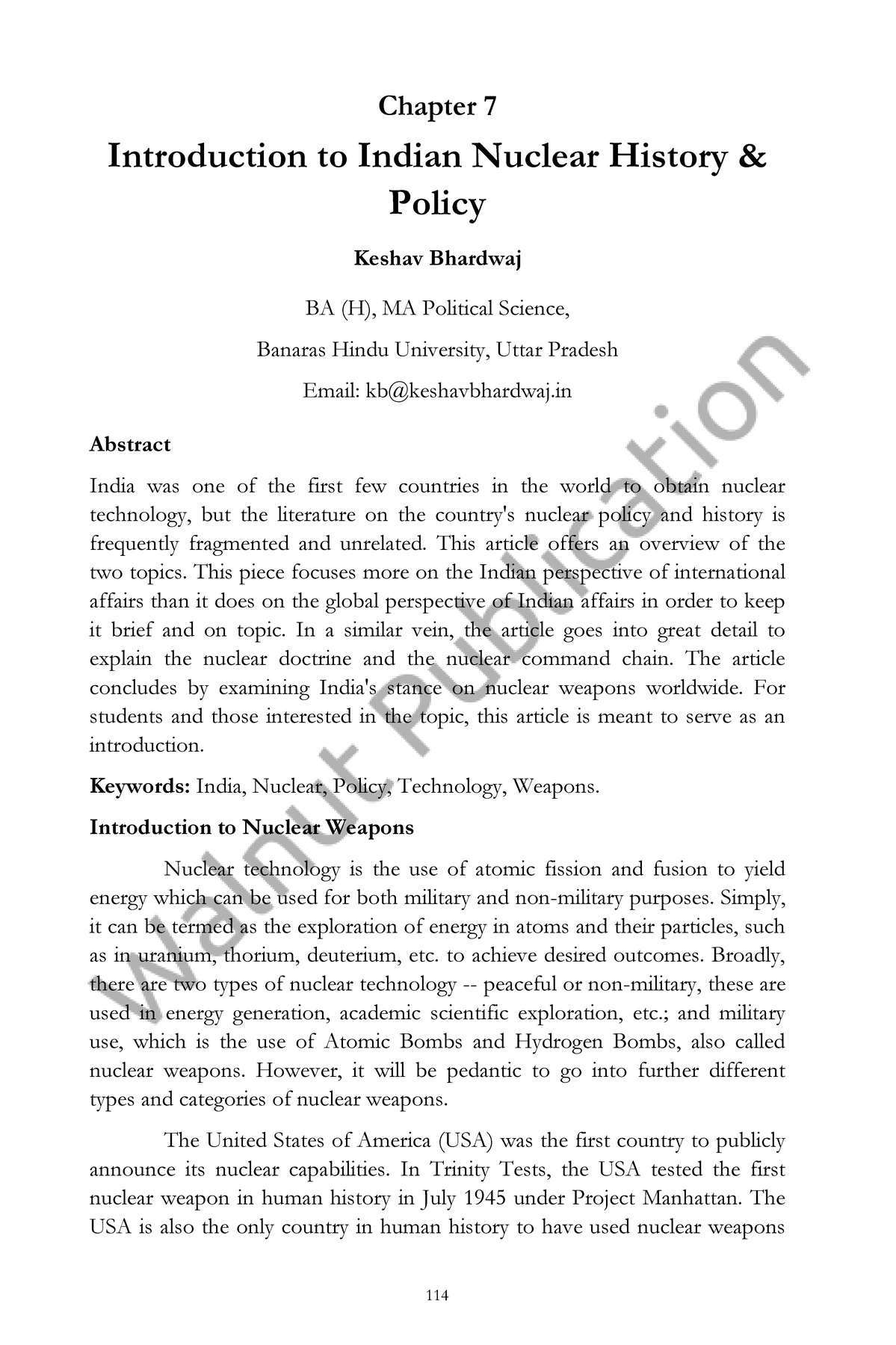
India was one of the first few countries in the world to obtain nuclear technology, but the literature on the country's nuclear policy and history is frequently fragmented and unrelated. This chapter offers a concise, integrated overview of India's nuclear trajectory. Focusing on the Indian strategic perspective of international affairs, it details the structural imperatives behind India's transition from peaceful nuclear research to overt weaponisation (Pokhran-I and Pokhran-II), explains the civilian-led command architecture and the operational elements of India's nuclear doctrine—including Credible Minimum Deterrence (CMD), No First Use (NFU), and Massive Unacceptable Damage (MUD)—and evaluates India's enduring advocacy for universal, non-discriminatory nuclear disarmament.
Inside the Chapter
-
Early Foundations & Operation Smiling Buddha (1974)
Traces the origins of Indian nuclear research under Homi Bhabha at TIFR and the Atomic Energy Commission (1948), moving from civilian exploration to strategic deterrence following the 1962 Sino-Indian War, China's 1964 Lop Nur test, gunboat diplomacy during the 1971 Bangladesh Liberation War (USS Enterprise), and the discriminatory NPT 'nuclear apartheid', culminating in Operation Smiling Buddha at Pokhran in May 1974.
-
Operation Shakti & The Road to Pokhran-II (1998)
Analyzes the geopolitical pressures compelling overt weaponisation: Sino-Pakistani nuclear and missile proliferation (M-9 and M-11), post-Cold War loss of Soviet security guarantees, the indefinite extension of the NPT, and coercive CTBT deadlines, leading to the underground tests of May 11–13, 1998 under Prime Minister Atal Bihari Vajpayee.
-
Military Doctrine: Deterrence, NFU & Command Structure
Examines the 1999 draft and 2003 operationalized Nuclear Doctrine, unpacking Credible Minimum Deterrence (CMD), the No First Use (NFU) pledge with retaliatory caveats for chemical/biological attacks, Massive Unacceptable Damage (MUD), and the two-tier Nuclear Command Authority (NCA) comprising the Political Council headed by the Prime Minister and the Executive Council headed by the NSA.
-
Global Disarmament Diplomacy & The Realist-Constructivist Synthesis
Documents India's historic leadership in universal, non-discriminatory disarmament (1954 testing ban, 1988 Rajiv Gandhi Action Plan), its post-1998 bilateral integration through the Indo-US Civil Nuclear Agreement and NSG waiver, concluding that Indian nuclear policy represents a realist tree of national survival blossoming with constructivist normative aspirations.
Reference
Bhardwaj, K. (2023). Introduction to Indian Nuclear History & Policy. In M. Bansal (Ed.), Basic Concepts of India’s Foreign Policy: Perspectives and Dynamics in the 21st Century (pp. 114–123). Walnut Publication.
@incollection{bhardwaj2023nuclearpolicy,
  title={Introduction to Indian Nuclear History \& Policy},
  author={Bhardwaj, Keshav},
  booktitle={Basic Concepts of India's Foreign Policy: Perspectives and Dynamics in the 21st Century},
  editor={Bansal, Meenakshi},
  pages={114--123},
  publisher={Walnut Publication},
  year={2023},
  month={dec},
  isbn={978-93-5911-369-2},
  url={https://www.walnutpublication.com/book/9789359113692/}
}
About Publication
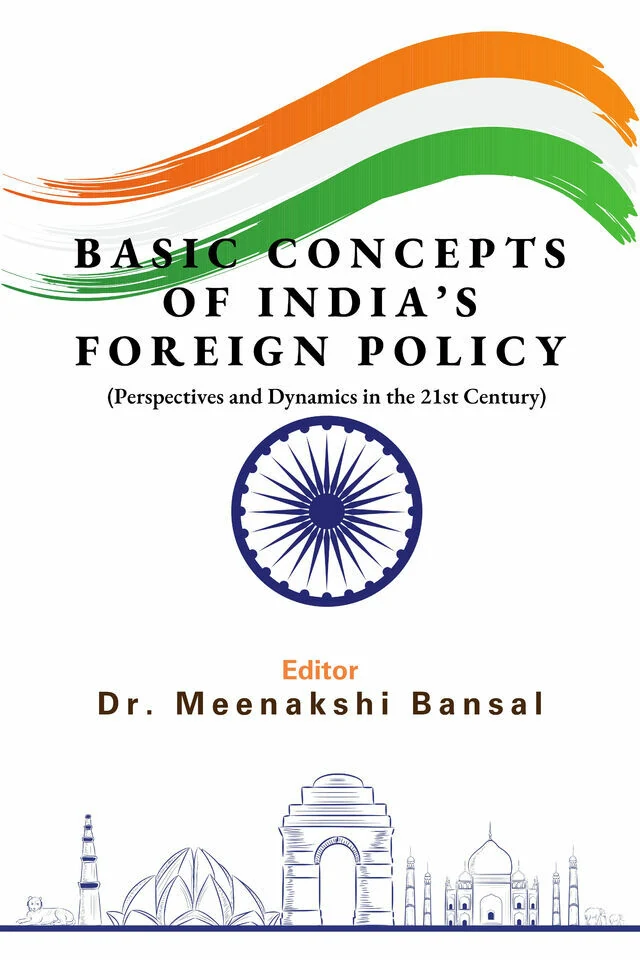
Basic Concepts of India’s Foreign Policy (Perspectives and Dynamics in the 21st Century) (First Edition)
Basic Concepts of India’s Foreign Policy (Perspectives and Dynamics in the 21st Century), edited by Dr. Meenakshi Bansal, brings together 24 scholarly contributions from Indian and international researchers exploring India’s evolving diplomatic architecture, strategic doctrines, and geopolitical engagements in an increasingly multipolar global order. The volume examines key facets of Indian foreign policy including non-alignment, security dynamics, nuclear deterrence, bilateral relationships with major powers, and multilateral engagements.
About Publisher
Walnut Publication
Walnut Publication is an independent academic and trade publisher based in India, the UK, and the USA. It publishes scholarly books, edited volumes, monographs, and conference proceedings across humanities, social sciences, management, and technology, supporting global distribution through academic libraries and major international book platforms.